
BHMS 1st year · Anatomy, Histology & Embryology
Thorax — the first-year Anatomy chapter on the chest, the heart and the lungs
A study guide to the Thorax chapter of first-year Anatomy: airway, lungs, heart, the mediastinum and its vessels, and the diaphragm.
Vaibhav Kumar Rai · · 3 min read
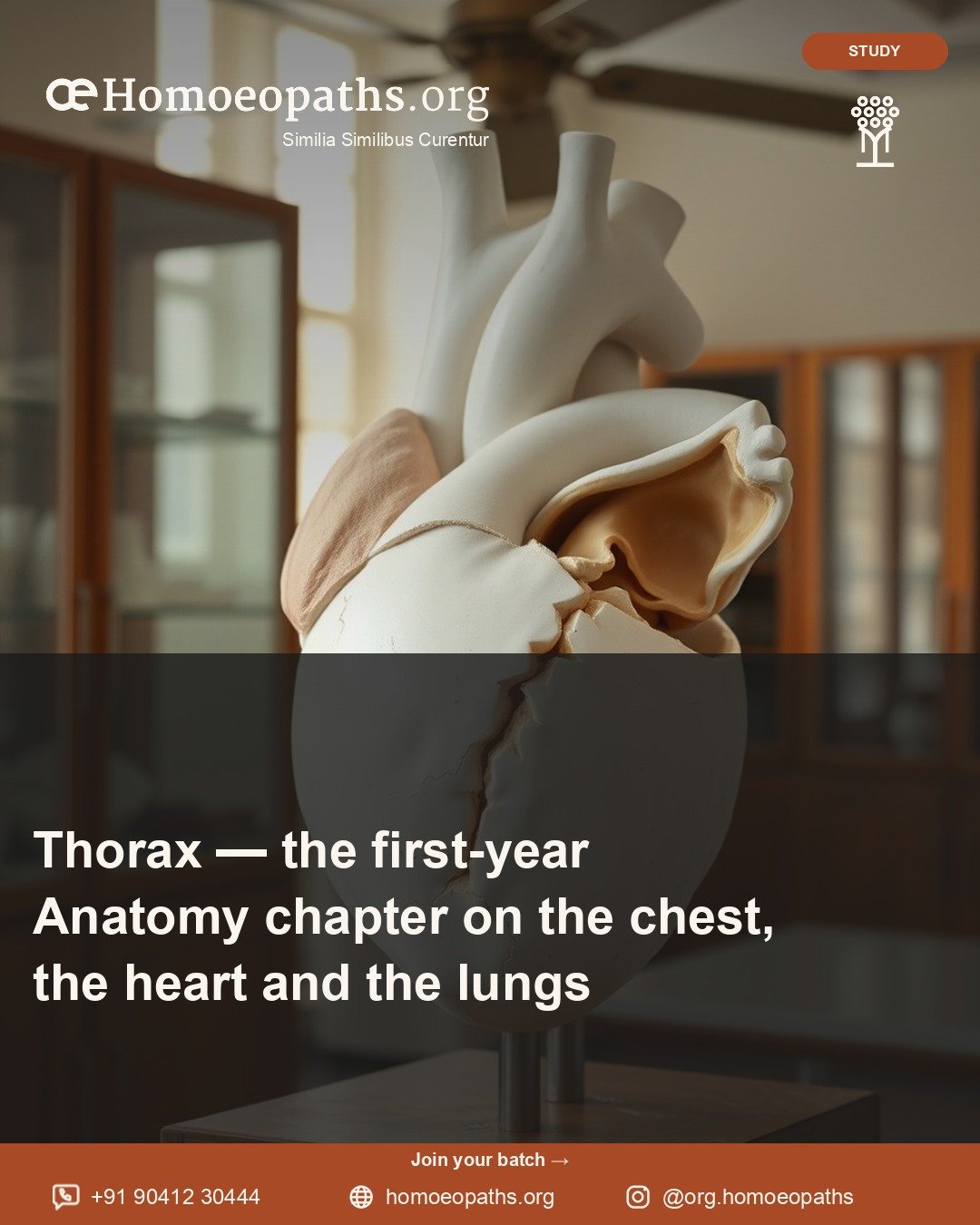
Put your hand flat on your chest. Under it, your heart beats and your lungs fill and empty. The thorax is the chest, and this chapter is about what lives inside it.
The NCH syllabus lists Thorax as chapter six of Anatomy, Histology and Embryology (HomUG-AHE). The sheet has sixteen lines. Apart from “Introduction” and “Revision”, they fall into four parts: the airway and lungs, the heart, the middle space called the mediastinum, and the diaphragm. It also carries one embryology line and one histology line. This piece goes through each part in turn.
Part one: the airway and the lungs
- Trachea
- Pleura
- Lungs
The trachea is the windpipe. It carries air down towards the lungs. The pleura is a thin, two-layered covering around each lung. The lungs are the organs where breathing does its work.
Learn the lungs by their surfaces, borders and lobes, and by what touches them. Your textbook will set out the details.
Part two: the mediastinum
- Mediastinum
- Superior mediastinum: arch of aorta
- Superior mediastinum: superior vena cava
- Posterior mediastinum: azygous vein and thoracic duct
- Posterior mediastinum: oesophagus and descending thoracic aorta
- Inferior vena cava
The mediastinum is the space in the middle of the chest, between the two lungs. Anatomists divide it into parts. The sheet names two of them, the superior (upper) and the posterior (back) parts, and lists what you must know in each.
A quick word on the names. The aorta is the main artery leaving the heart. Its “arch” is the curve it makes at the top. The superior and inferior venae cavae are the two big veins that bring blood back to the heart. The azygous vein is a vein that runs up the back of the chest. The thoracic duct is the main lymph channel. The oesophagus is the food pipe.
A good way in: draw the mediastinum as a box, split into its parts. Then write each structure from the sheet into the part it belongs to. One diagram will hold most of this group.
Part three: the heart
- Pericardium and heart
- Blood supply of heart
The pericardium is the sac that wraps the heart. The heart itself has chambers, valves and walls, and your textbook will take you through each. The second line is about the heart’s own blood supply. The heart pumps blood to the body, but its muscle also needs blood. The vessels that feed it are part of this topic.
Part four: the diaphragm
- Diaphragm
The diaphragm is the dome-shaped muscle that forms the floor of the chest. It separates the thorax from the abdomen. It is also the main muscle of breathing. Structures pass through it from chest to belly, so it links this chapter to the next one.
The embryology and histology lines
The thorax chapter carries two lines from other parts of the subject.
Systemic embryology: development of heart and lung. How these organs form before birth. It builds on chapter two, Embryology.
Systemic histology: trachea and lung. How their tissues look under the microscope. It builds on chapter three, general Histology.
These lines are easy to skip while you are busy with the heart. Do not skip them. Put them on your plan from the start.
How the chapter sits in the year
Thorax is the first chapter on the trunk. It comes after the two limb chapters and before Abdomen, Pelvis and Perineum. The diaphragm is the border between the two.
The same organs return in first-year Physiology. Its Cardio-Vascular System chapter studies how the heart works. Its Respiratory System chapter studies how breathing works. Anatomy gives you the structure. Physiology then shows you the work.
What to take from it
- See the chapter in four parts: airway and lungs, mediastinum, heart, diaphragm.
- Draw the mediastinum as a box and place each listed structure in it.
- Know what the pericardium is and how the heart gets its own blood.
- Keep the embryology and histology lines on your plan.
The sheet names the topics and stops there. Depth and diagrams come from your textbook, your dissection hall and your teachers.
Where to go next on the platform
This piece is part of the first-year Anatomy, Histology and Embryology room. “Abdomen, Pelvis and Perineum — the first-year Anatomy chapter below the diaphragm” is the chapter that comes next. “Physiology and Biochemistry in the First Year — how the body works” shows where the heart and lungs return in Physiology.
Written by Vaibhav Kumar Rai · Published by Homoeopaths.org · 27 October 2026
"Thorax — the first-year Anatomy chapter on the chest, the heart and the lungs." Homoeopaths.org. Published 27 October 2026. https://homoeopaths.org/learn/courses/bhms-1st-year/anatomy-histology-embryology/thorax-1st-year
More in BHMS 1st year · Anatomy, Histology & Embryology
Anatomy, Histology & Embryology
Lower Extremity — the first-year Anatomy chapter on the leg, from hip to sole
A study guide to the Lower Extremity chapter of first-year Anatomy: thigh, gluteal region, leg and foot, with their nerves, arteries and joints.
Vaibhav Kumar Rai · 25 October 2026 · 4 min read
Anatomy, Histology & Embryology
Histology (General) — the first-year Anatomy chapter where the body goes under the microscope
A study guide to general Histology in first-year Anatomy: ten kinds of tissue and organ, seen under the microscope, and how to study them.
Vaibhav Kumar Rai · 24 October 2026 · 3 min read
Anatomy, Histology & Embryology
Head, Neck and Face — the first-year Anatomy chapter where many small parts share a small space
A study guide to Head, Neck and Face in first-year Anatomy: neck triangles, glands, the orbit, mouth, throat, ear, nose and the great vessels.
Vaibhav Kumar Rai · 24 October 2026 · 4 min read
Anatomy, Histology & Embryology
General Anatomy — the first-year Anatomy chapter that teaches the language of the body
A study guide to General Anatomy, chapter one of first-year Anatomy: the cell, basic tissues, genetics, and the words every later chapter uses.
Vaibhav Kumar Rai · 23 October 2026 · 4 min read