
BHMS 1st year · Homoeopathic Pharmacy
Ideal laboratory — the first-year Pharmacy chapter on the room where you learn by doing
What makes a good general laboratory, why safety rules come first, and why the lab matters so much in homoeopathic pharmacy education.
Vaibhav Kumar Rai · · 4 min read
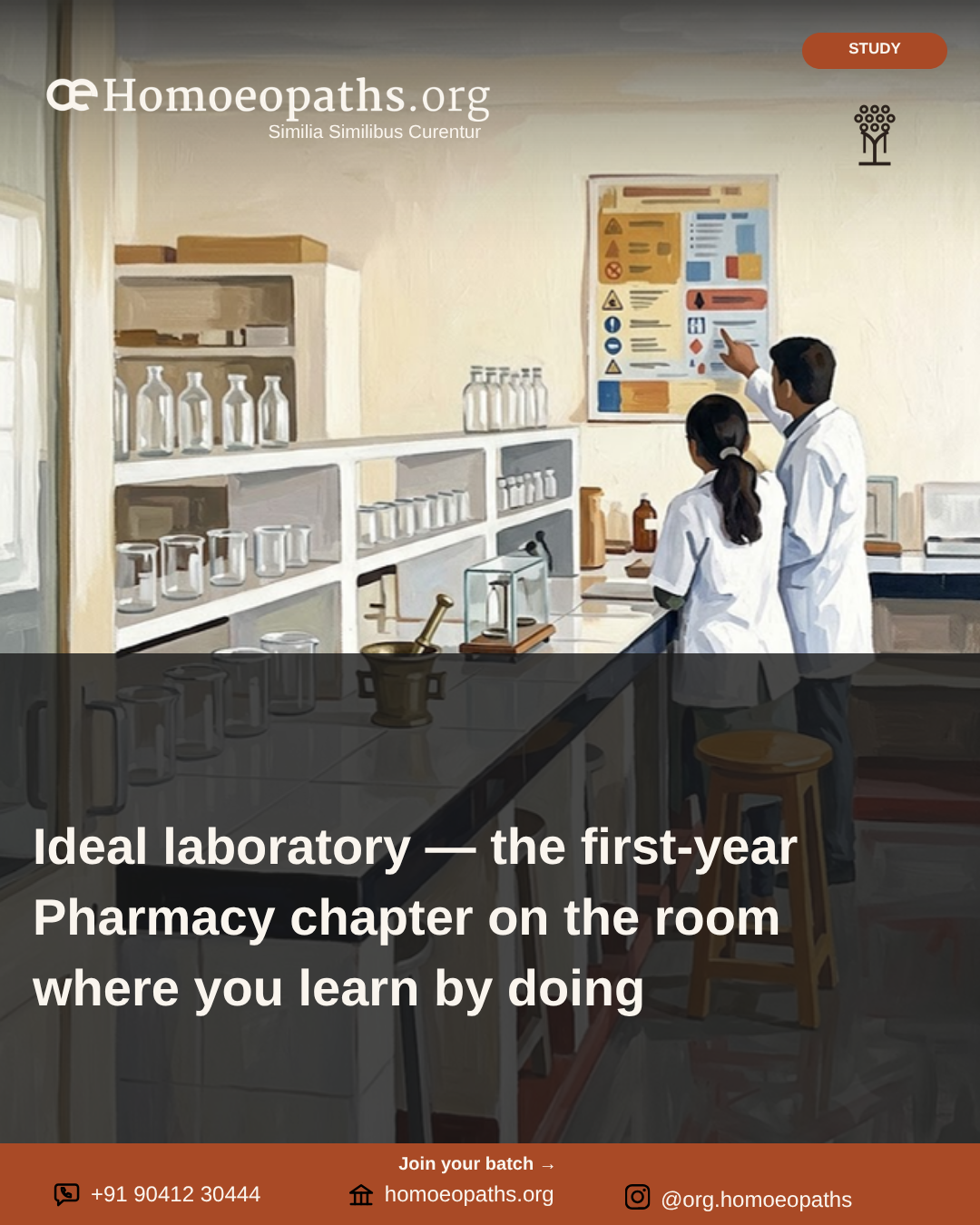
Some subjects live in the lecture hall. Homoeopathic Pharmacy lives partly in the laboratory. You will prepare, measure, test and store things with your own hands. So before any of that starts, the syllabus stops to ask a simple question. What should a good laboratory look like?
That is this chapter. The NCH syllabus calls it “Ideal laboratory”. It is the fourth chapter of HomUG-HP, the code for first-year Homoeopathic Pharmacy. It is short. The sheet lists just two topics. But what you learn here shapes every practical class that follows.
Topic one: what a good lab needs, and how to stay safe
The first topic reads “Pre requisites of ideal Laboratory (General Laboratory), Laboratory safety Rules”. It has two halves.
Prerequisites are the things that must be in place before work can begin. An “ideal” laboratory is the standard you aim for. The words in brackets matter too: “General Laboratory”. So this topic is about the basic needs of any working lab, not a special one.
The syllabus does not list the prerequisites. Your textbook and teachers will give you the full list. When they do, it helps to sort each item into a simple question. Is it about the space? The equipment? The people? The records? A list sorted that way is easier to remember and easier to write out in an exam.
The second half is Laboratory safety Rules. In a lab you may handle glass, heat, alcohol and powders. Things can break, spill or catch fire. Safety rules exist so that nobody gets hurt and no work is spoiled.
Take this half seriously from day one. Your college lab will have its own rules, often posted on the wall. Read them before your first practical, not after. Ask your lab staff if anything is unclear. A good habit formed in first year stays with you for the rest of your career.
Topic two: why the lab matters in your education
The second topic reads “Role of Laboratory in Homoeopathic Pharmacy Education”.
This is the “why” behind the chapter. Pharmacy is a practical subject. You can read about a method many times and still not understand it. Then you do it once with your own hands, and it clicks. The laboratory is where that happens.
Look ahead in your syllabus and you will see how much depends on it. Later chapters in first-year Pharmacy cover vehicles and their purity tests, the preparation of mother tinctures, the scales of potentization, and quality control. Each of these has a hands-on side. The lab is where theory turns into skill.
So this topic asks you to see the lab not as a room you visit, but as part of how you learn. Your teachers will explain its role in detail. Your job is to arrive at each practical ready to learn by doing.
How this chapter sits in the year
First-year Pharmacy has thirty-two chapters. This is the fourth. It comes after the subject’s basics and the chapter on pharmacopoeias. It comes just before “Weights and measurements”.
That order makes sense. First you learn what the subject is. Then you meet the rule books that set its standards. Then you learn about the room where you will work. Then you learn how to measure accurately inside that room. Each step prepares you for the next.
The lab idea returns later in the year as well. Chapter twenty-eight covers the Homoeopathic Pharmacopoeia Laboratory, or HPL, and its role in the quality control of drugs. That is a national body, not a college lab. But the same thinking runs through both: careful work, done to a standard, in the right setting.
What to take from it
Three things are worth keeping.
First, know the prerequisites of a general laboratory. Sort them into simple groups so you can recall them quickly.
Second, know your safety rules, and follow them. In the lab, safety is not a topic you study once. It is how you work every single day.
Third, understand why the lab matters. Homoeopathic pharmacy is learned with the hands as much as the head. The laboratory is where your later chapters become real.
A note for care-seekers reading this
If you are not a student, this chapter tells you something useful. Homoeopathic medicines are meant to be prepared by trained people, in proper settings, to set standards. That is what students are taught from their first months. Preparing medicines at home is not part of that picture.
Where to go next on the platform
This piece sits in the first-year Homoeopathic Pharmacy room. The chapter after it, “Weights and measurements”, is in the same room. For the rule books behind lab standards, read “Homoeopathic Pharmacopoeia” there too. And “How Homoeopathic Remedies Are Made”, on the Understanding Homoeopathy shelf, explains the preparation process in plain terms for any reader.
The syllabus sheet names two topics and nothing more. This piece explains what they ask, in plain words. The detail comes from your college, your lab staff and your teachers.
Written by Vaibhav Kumar Rai · Published by Homoeopaths.org · 8 October 2026
"Ideal laboratory — the first-year Pharmacy chapter on the room where you learn by doing." Homoeopaths.org. Published 8 October 2026. https://homoeopaths.org/learn/courses/bhms-1st-year/homoeopathic-pharmacy/ideal-laboratory-1st-year
More in BHMS 1st year · Homoeopathic Pharmacy
Homoeopathic Pharmacy
Homoeopathic Pharmacopoeia Laboratory (HPL) — the first-year Pharmacy chapter on the national lab
A study guide to the HPL chapter of first-year Pharmacy: what the Homoeopathic Pharmacopoeia Laboratory does for drug quality, and the Pharmacopoeia Commission.
Vaibhav Kumar Rai · 17 October 2026 · 3 min read
Homoeopathic Pharmacy
Drug Proving — the first-year Pharmacy chapter on how a medicine is first known
A study guide to Drug Proving in first-year Pharmacy: pharmacodynamics, Organon aphorisms 105 to 145, later provings, the HPT and its protocols.
Vaibhav Kumar Rai · 16 October 2026 · 3 min read
Homoeopathic Pharmacy
Doctrine of Signature — the first-year Pharmacy chapter on an old idea, read with care
A study guide to the Doctrine of Signature in first-year Pharmacy: the basic idea, its place in older medicine, its supporters, and Hahnemann’s view.
Vaibhav Kumar Rai · 16 October 2026 · 3 min read
Homoeopathic Pharmacy
Dispensing of Homoeopathic Medicines — the first-year Pharmacy chapter on handing a medicine over
A study guide to the Dispensing chapter of first-year Pharmacy: solid and liquid dosage forms, the methods of dispensing, and where it sits in the year.
Vaibhav Kumar Rai · 15 October 2026 · 3 min read