
BHMS 1st year · Homoeopathic Pharmacy
Industrial pharmacy — the first-year Pharmacy chapter on making medicines at scale
A study guide to Industrial pharmacy in first-year Pharmacy: Good Manufacturing Practices, Schedule M1, and how the chapter fits the year’s quality block.
Vaibhav Kumar Rai · · 3 min read
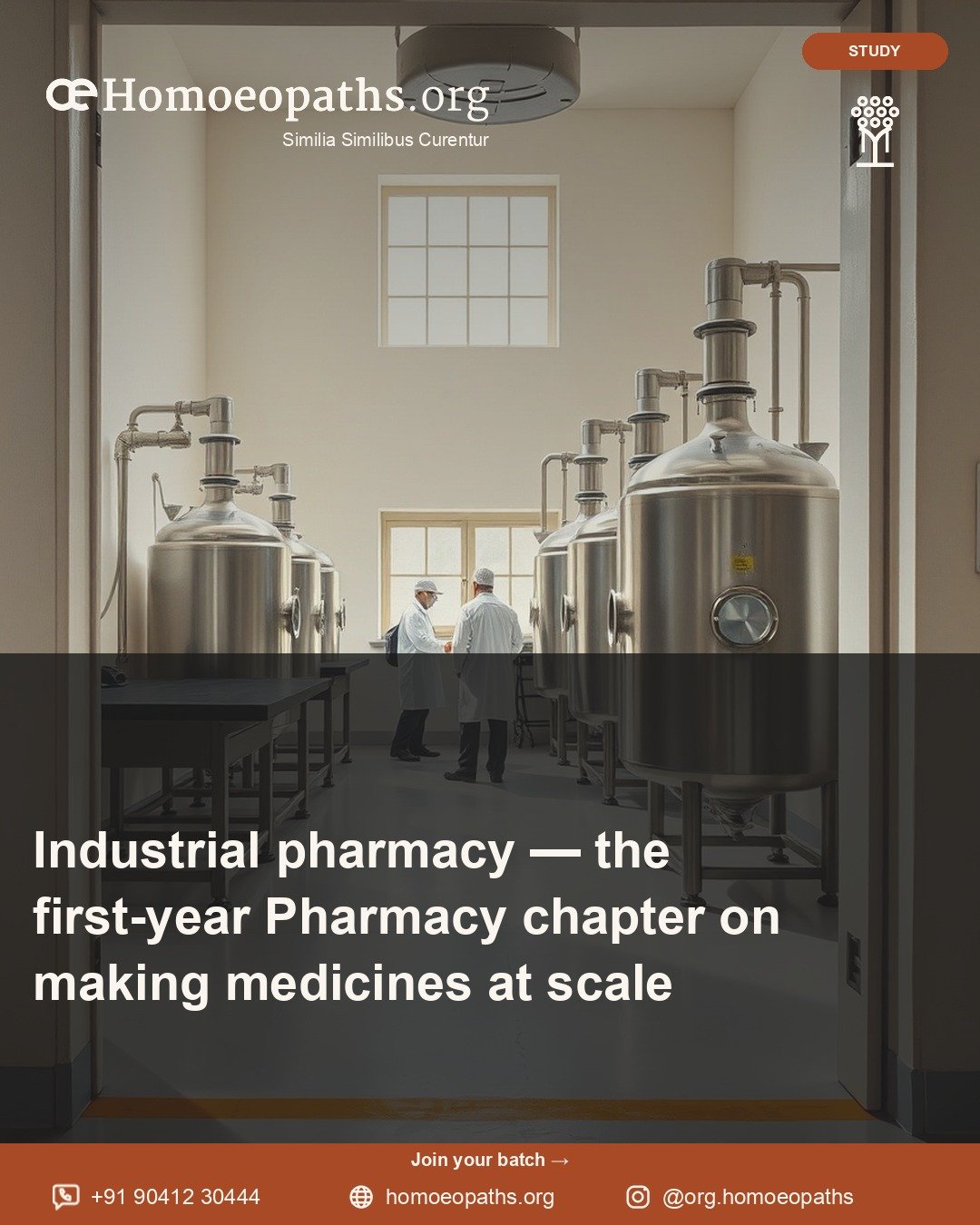
Most of first-year Pharmacy happens at the scale of a lab bench. One flask. One mortar. One student. But the medicines in a pharmacy are usually made in a factory, in large batches. Industrial pharmacy is the chapter about that bigger world.
The NCH syllabus gives “Industrial pharmacy” chapter twenty-seven of first-year Homoeopathic Pharmacy (HomUG-HP). The sheet lists two topics. Both are about rules for making medicines well. This piece explains what each one asks.
A note before we begin: this is a study page for BHMS students. It does not judge any company or product.
Topic one: Good Manufacturing Practices
The first topic reads “Good Manufacturing Practices (GMP)”.
GMP is a set of practices that a maker of medicines must follow. The word “good” here is not praise. It names an accepted standard. The idea is simple. Quality should be built into every step of making, not checked only at the end.
The sheet does not list what GMP covers. Your textbook will. As you read it, sort the points into a few groups. Useful groups might be the building, the people, the equipment, the materials, the process and the records. Check these against your textbook’s own headings and adjust.
Here is a link to hold on to. Chapter four, “Ideal laboratory”, covers the “Pre requisites of ideal Laboratory” and “Laboratory safety Rules”. Those are rules for a college lab. GMP is the same kind of thinking, applied to a factory. If you understood chapter four, you already have the shape of this topic.
Topic two: Schedule M1
The second topic reads “Schedule M1”.
A schedule is a named section of a set of legal rules. Schedule M1 is the one this chapter asks you to know. The sheet places it right beside GMP, in a chapter about making medicines. That tells you it belongs to the same family of ideas.
Chapter twenty-nine, “Legislations pertaining to Homoeopathic Pharmacy”, lists the Drugs and Cosmetics Act, 1940, and the Drugs and Cosmetics Rules, 1945. Ask your teachers where Schedule M1 sits among these laws. Knowing that link will help you answer questions in both chapters.
The sheet names the schedule but not its contents. Your textbook covers them. Learn the main requirements as a list, and note which of them match the GMP groups from topic one.
Why this chapter matters to a future doctor
A BHMS student may never work in a factory. So why learn this? Because the medicines a practitioner uses are made by someone else. Knowing what rules those makers must follow helps you understand what quality means, and what questions to ask about it.
How it sits in the year
Industrial pharmacy comes after “Standardisation in Homoeopathy” and before “Homoeopathic pharmacopoeia laboratory (HPL)”. These three chapters form the quality block at the end of the year.
- Standardisation covers checks at every stage, from raw material to finished product.
- Industrial pharmacy covers the rules for the place and process of making.
- The HPL chapter covers the national laboratory’s role in quality control of drugs.
There is also a link back to chapter fourteen, “External applications”. One of its topics is “Commercial Preparation of Ointment”. That is industrial pharmacy on a small scale, met earlier in the year.
What to take from it
- Know what GMP stands for, and the main idea behind it.
- Sort the GMP points from your textbook into clear groups.
- Know what Schedule M1 is, and find where it sits in the law.
- Link this chapter to “Ideal laboratory”, “Standardisation” and the HPL.
The sheet gives just two topic names. This piece explains what each asks and how they connect. The detail comes from your textbook and teachers.
Where to go next on the platform
This piece is in the first-year Homoeopathic Pharmacy room. “Ideal laboratory — the first-year Pharmacy chapter on the room where you learn by doing” is the small-scale version of this chapter. “External applications — the first-year Pharmacy chapter on preparations for outside the body” covers the commercial preparation of ointment.
Written by Vaibhav Kumar Rai · Published by Homoeopaths.org · 17 October 2026
"Industrial pharmacy — the first-year Pharmacy chapter on making medicines at scale." Homoeopaths.org. Published 17 October 2026. https://homoeopaths.org/learn/courses/bhms-1st-year/homoeopathic-pharmacy/industrial-pharmacy-1st-year
More in BHMS 1st year · Homoeopathic Pharmacy
Homoeopathic Pharmacy
Homoeopathic Pharmacopoeia Laboratory (HPL) — the first-year Pharmacy chapter on the national lab
A study guide to the HPL chapter of first-year Pharmacy: what the Homoeopathic Pharmacopoeia Laboratory does for drug quality, and the Pharmacopoeia Commission.
Vaibhav Kumar Rai · 17 October 2026 · 3 min read
Homoeopathic Pharmacy
Drug Proving — the first-year Pharmacy chapter on how a medicine is first known
A study guide to Drug Proving in first-year Pharmacy: pharmacodynamics, Organon aphorisms 105 to 145, later provings, the HPT and its protocols.
Vaibhav Kumar Rai · 16 October 2026 · 3 min read
Homoeopathic Pharmacy
Doctrine of Signature — the first-year Pharmacy chapter on an old idea, read with care
A study guide to the Doctrine of Signature in first-year Pharmacy: the basic idea, its place in older medicine, its supporters, and Hahnemann’s view.
Vaibhav Kumar Rai · 16 October 2026 · 3 min read
Homoeopathic Pharmacy
Dispensing of Homoeopathic Medicines — the first-year Pharmacy chapter on handing a medicine over
A study guide to the Dispensing chapter of first-year Pharmacy: solid and liquid dosage forms, the methods of dispensing, and where it sits in the year.
Vaibhav Kumar Rai · 15 October 2026 · 3 min read