
BHMS 1st year · Homoeopathic Pharmacy
Mother tincture and its preparation — a first-year Pharmacy chapter, for students
A study guide to the Mother tincture chapter: extraction, the old nine-class method, uniform drug strength, moisture content and the modern approach.
Vaibhav Kumar Rai · · 4 min read
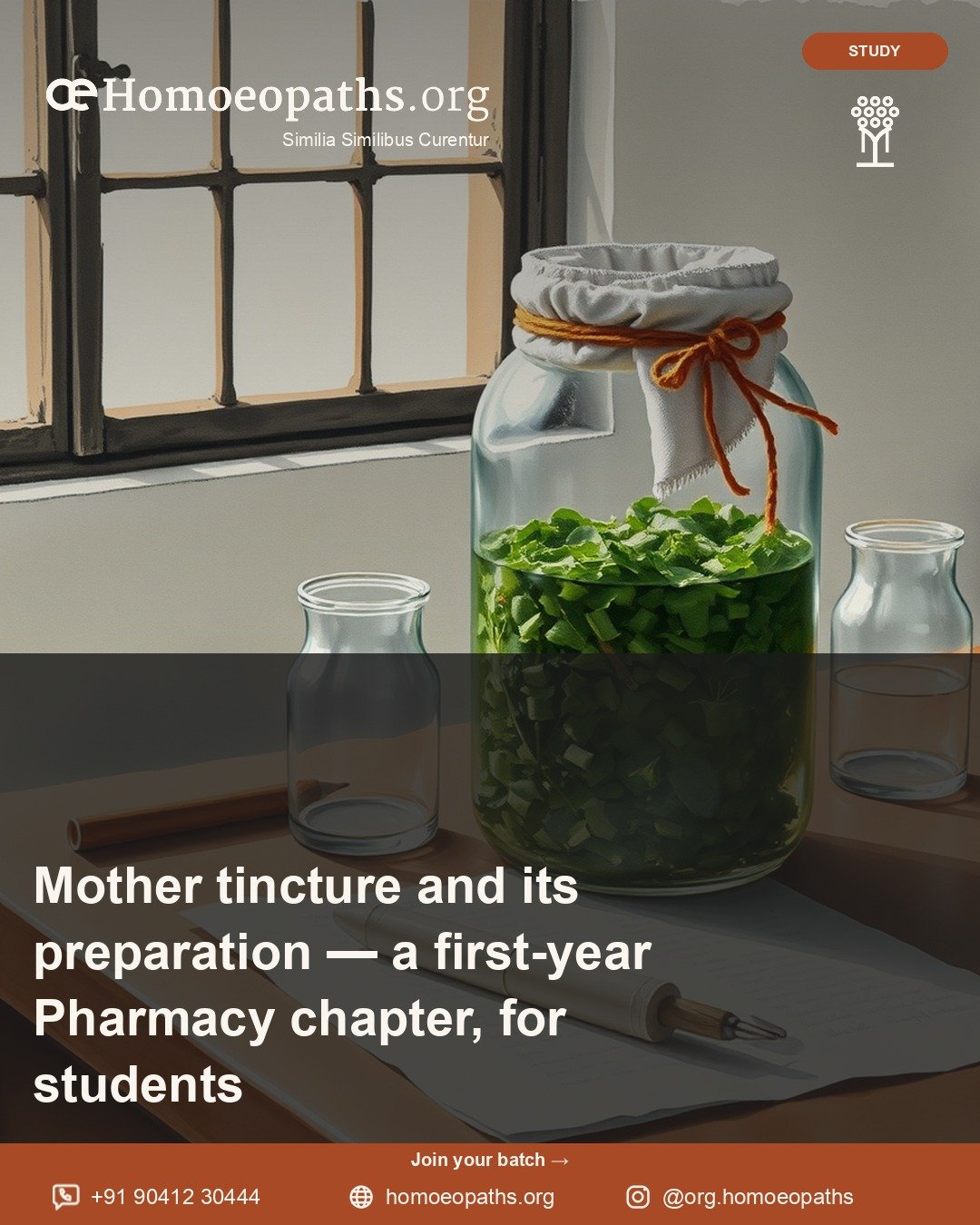
Many homoeopathic medicines begin as a liquid drawn out of a raw drug. That first liquid has a name. It is called the mother tincture. Much of what comes later in pharmacy starts from it, which is where the “mother” in the name comes from.
The NCH syllabus gives it chapter eleven of HomUG-HP, first-year Homoeopathic Pharmacy. The sheet lists five topics. This piece takes them one by one, in plain words, for BHMS students.
Topic one: extraction
The first topic reads “Extraction – Principles & Various Methods”.
Extraction means drawing something out. Here, it means drawing the useful part of a raw drug out into a liquid. You will learn the principles first, meaning the ideas that explain why extraction works. Then you will learn the methods, meaning the different ways it can be done.
Keep principles and methods on separate pages in your notes. Principles answer “why”. Methods answer “how”. Exam questions often ask for one and not the other.
Topic two: the old method
The second topic reads “Old Method (Based on Class I to IX)”.
In the older way of preparing mother tinctures, drugs were sorted into classes. The sheet tells you there were nine of them, numbered I to IX. Each class had its own way of preparation.
The sheet does not list what goes in each class. Your textbook does. A nine-row table works well here: one row per class, with what belongs in it and how it is prepared. Nine is a lot to hold in memory, so build the table slowly and test yourself on it.
Why learn an old method? Because older books and older records use it. And because you cannot understand why the new method exists until you know what it replaced.
Topic three: uniform drug strength
The third topic reads “Concept of Uniform Drug Strength”.
“Uniform” means the same every time. So this is the idea that a mother tincture should have the same strength, batch after batch. A tincture made this month should match one made last year.
This is a quality idea. It links to chapter twenty-six, “Standardisation in Homoeopathy”, which you meet later in the year. Standardisation is the wider subject. Uniform drug strength is one clear example of it.
Topic four: moisture content
The fourth topic reads “Estimation of Moisture Content – Necessity”.
Estimation here means measuring. Moisture content means how much water is in the raw drug. The word “Necessity” tells you the sheet wants you to know why this measurement is needed.
Here is one way to see the link. Raw drugs, especially fresh plants, can hold very different amounts of water. If you want uniform strength, you need to know how much of your raw drug is water and how much is the drug itself. So topics three and four belong together. Your textbook will give the full reasoning and the method. Learn the “why” in your own words, and it will stay with you.
Topic five: the new method
The fifth topic reads “New Method/Modern Approach of Homoeopathic Drug Preparation”.
This is the method used today. It is the answer to the limits of the old nine-class system. When you study it, keep asking one question: what does the new method do better than the old one? A short comparison table, old against new, is one of the most useful things you can make for this chapter.
How this chapter sits in the year
First-year Pharmacy has thirty-two chapters. This is the eleventh. It follows “Vehicles” and comes before “Various Scales of Potentization in Homoeopathic pharmacy”.
The order is a chain. You collect the drug. You learn the vehicles, such as alcohol. You prepare the mother tincture. Then you learn the scales used to take preparation further. Each chapter hands something to the next.
It also links back. Chapter three, on the Homoeopathic Pharmacopoeia, covers monographs. A monograph is the official entry for a drug, and preparation details belong there. And chapter five, “Weights and measurements”, is the skill you use every time you prepare anything.
What to take from it
First, know the principles of extraction and the main methods, and keep them apart.
Second, learn the old method’s nine classes as a table.
Third, understand uniform drug strength and why moisture content must be measured. See how the two ideas connect.
Fourth, compare the old method with the modern approach, point by point.
The sheet names these five topics and nothing more. This piece explains what each one asks. The classes, methods and figures come from your textbook and your practical classes.
Where to go next on the platform
This piece sits in the first-year Homoeopathic Pharmacy room. “Homoeopathic Pharmacopoeia — the rule books of first-year Pharmacy” is in the same room and explains monographs. “Homoeopathic Pharmacy in the First Year — from source to standard” gives the whole subject in one view. For readers outside the course, “How Homoeopathic Remedies Are Made” on the blog describes preparation in general terms.
Written by Vaibhav Kumar Rai · Published by Homoeopaths.org · 12 October 2026
"Mother tincture and its preparation — a first-year Pharmacy chapter, for students." Homoeopaths.org. Published 12 October 2026. https://homoeopaths.org/learn/courses/bhms-1st-year/homoeopathic-pharmacy/mother-tincture-and-its-preparation-1st-year
More in BHMS 1st year · Homoeopathic Pharmacy
Homoeopathic Pharmacy
Homoeopathic Pharmacopoeia Laboratory (HPL) — the first-year Pharmacy chapter on the national lab
A study guide to the HPL chapter of first-year Pharmacy: what the Homoeopathic Pharmacopoeia Laboratory does for drug quality, and the Pharmacopoeia Commission.
Vaibhav Kumar Rai · 17 October 2026 · 3 min read
Homoeopathic Pharmacy
Drug Proving — the first-year Pharmacy chapter on how a medicine is first known
A study guide to Drug Proving in first-year Pharmacy: pharmacodynamics, Organon aphorisms 105 to 145, later provings, the HPT and its protocols.
Vaibhav Kumar Rai · 16 October 2026 · 3 min read
Homoeopathic Pharmacy
Doctrine of Signature — the first-year Pharmacy chapter on an old idea, read with care
A study guide to the Doctrine of Signature in first-year Pharmacy: the basic idea, its place in older medicine, its supporters, and Hahnemann’s view.
Vaibhav Kumar Rai · 16 October 2026 · 3 min read
Homoeopathic Pharmacy
Dispensing of Homoeopathic Medicines — the first-year Pharmacy chapter on handing a medicine over
A study guide to the Dispensing chapter of first-year Pharmacy: solid and liquid dosage forms, the methods of dispensing, and where it sits in the year.
Vaibhav Kumar Rai · 15 October 2026 · 3 min read