
BHMS 1st year · Homoeopathic Pharmacy
Vehicles — the first-year Pharmacy chapter on what carries a medicine
A study guide to the Vehicles chapter: what a vehicle is, how vehicles are grouped, lactose and alcohol, and purity tests for water, alcohol and milk sugar.
Vaibhav Kumar Rai · · 4 min read
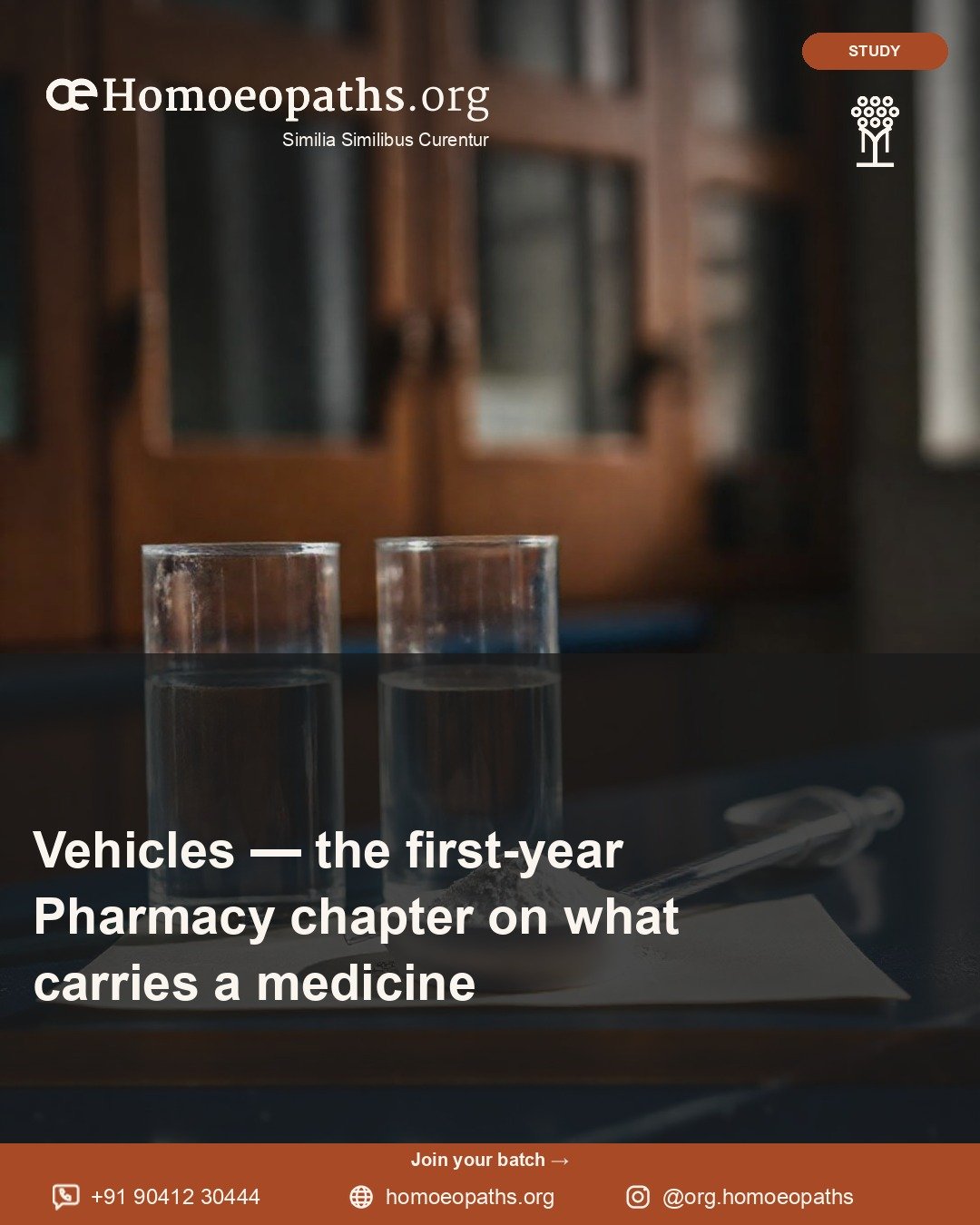
A homoeopathic medicine never travels alone. It is always carried by something else. A liquid, a powder, a small globule. In pharmacy, that carrier has a name. It is called a vehicle.
The NCH syllabus gives vehicles a full chapter. It is chapter ten of HomUG-HP, the code for first-year Homoeopathic Pharmacy. The sheet lists four topics. This piece walks through each one in plain words, as a study guide for BHMS students.
Topic one: definition, classification, general use
The first topic reads “Definition, classification, General Use”. It is the base of the chapter.
Definition. A vehicle is the substance that carries the medicine. It is the medium in which a drug is prepared, kept or given. Learn your textbook’s exact definition word for word. Examiners like a clean definition.
Classification. Vehicles are sorted into groups. The sheet does not print the groups. Your textbook will. One simple way to picture it: some vehicles are liquids and some are solids. Your book may use a finer system, so follow it.
General use. This is about the jobs vehicles do across pharmacy as a whole. Before you learn single vehicles, you learn why vehicles are needed at all.
Topic two: each vehicle in detail
The second topic reads “Source, Properties & Particular use of Vehicles with respect to List Provided in Appendix D”.
This is the heavy part of the chapter. For each vehicle on a set list, you learn three things:
- Source. Where the vehicle comes from.
- Properties. What it is like. How it looks, how it behaves.
- Particular use. The special job that vehicle does in homoeopathic pharmacy.
The list itself sits in Appendix D of the curriculum. An honest note here: our syllabus map does not copy out that appendix. Your college copy of the NCH curriculum has it, and your teachers will work from it. Get the list early. Then make one card per vehicle, with the three headings above.
Topic three: preparing lactose and alcohol
The third topic reads “Preparation – Commercial Lactose, Alcohol”. Two vehicles get special attention here, because they are used so widely.
Lactose is the sugar found in milk. You will also meet its older name, “sugar of milk”. The word “commercial” matters. The topic is about how lactose is made on a large scale for use in pharmacy.
Alcohol is the second. Here too, the topic is about how it is prepared for pharmaceutical use.
Learn each preparation as a set of steps, in order. Steps are easier to remember as a numbered list than as a paragraph.
Topic four: purity tests
The fourth topic reads “Purity tests – Water, Alcohol, Sugar of Milk”. Three vehicles, each with its own tests.
Why test purity at all? Because a vehicle is part of every medicine it carries. If the vehicle is not pure, the medicine is not what it claims to be. A good pharmacy checks, and does not assume.
Water is on this list too. It is easy to forget that water is a vehicle. But it is, and it must be tested like the others.
The sheet does not give the tests. Your textbook and your practical classes will. When you learn them, write down three things for each test: what you do, what you see, and what result tells you the sample is pure.
How this chapter sits in the year
First-year Pharmacy has thirty-two chapters. This is the tenth. It follows “Collection of drug substances” and comes just before “Mother tincture and its preparation”.
That order makes sense. First you gather the drug. Then you learn the substances that will carry it. Then you learn how the first liquid preparation is made.
Vehicles also come back later in the year. Chapter seventeen, “Dispensing of Homoeopathic Medicines”, covers solid and liquid dosage forms, and those forms are built on vehicles. Chapter twenty, “Preservation”, has preservation rules for vehicles too. So the cards you make now will help you twice more before the year ends.
What to take from it
First, be able to define a vehicle and name how vehicles are classified.
Second, get the Appendix D list and learn source, properties and use for each item.
Third, know how commercial lactose and alcohol are prepared, step by step.
Fourth, know the purity tests for water, alcohol and sugar of milk. Practise them in the lab, not only on paper.
The sheet names the topics but not the detail. This piece explains what each topic asks. The facts to memorise come from your textbook and your teachers.
Where to go next on the platform
This piece lives in the first-year Homoeopathic Pharmacy room. “Weights and measurements — the first-year Pharmacy chapter on measuring right” is in the same room, and you will need it when you prepare vehicles in the lab. “Ideal laboratory — the first-year Pharmacy chapter on the room where you learn by doing” covers the lab itself. For a general reader’s view of the subject, see the Homoeopathic Pharmacy topic in Homoeopathy Knowledge.
Written by Vaibhav Kumar Rai · Published by Homoeopaths.org · 14 October 2026
"Vehicles — the first-year Pharmacy chapter on what carries a medicine." Homoeopaths.org. Published 14 October 2026. https://homoeopaths.org/learn/courses/bhms-1st-year/homoeopathic-pharmacy/vehicles-1st-year
More in BHMS 1st year · Homoeopathic Pharmacy
Homoeopathic Pharmacy
Homoeopathic Pharmacopoeia Laboratory (HPL) — the first-year Pharmacy chapter on the national lab
A study guide to the HPL chapter of first-year Pharmacy: what the Homoeopathic Pharmacopoeia Laboratory does for drug quality, and the Pharmacopoeia Commission.
Vaibhav Kumar Rai · 17 October 2026 · 3 min read
Homoeopathic Pharmacy
Drug Proving — the first-year Pharmacy chapter on how a medicine is first known
A study guide to Drug Proving in first-year Pharmacy: pharmacodynamics, Organon aphorisms 105 to 145, later provings, the HPT and its protocols.
Vaibhav Kumar Rai · 16 October 2026 · 3 min read
Homoeopathic Pharmacy
Doctrine of Signature — the first-year Pharmacy chapter on an old idea, read with care
A study guide to the Doctrine of Signature in first-year Pharmacy: the basic idea, its place in older medicine, its supporters, and Hahnemann’s view.
Vaibhav Kumar Rai · 16 October 2026 · 3 min read
Homoeopathic Pharmacy
Dispensing of Homoeopathic Medicines — the first-year Pharmacy chapter on handing a medicine over
A study guide to the Dispensing chapter of first-year Pharmacy: solid and liquid dosage forms, the methods of dispensing, and where it sits in the year.
Vaibhav Kumar Rai · 15 October 2026 · 3 min read