
BHMS 1st year · Physiology & Biochemistry
Digestive System and Nutrition — the first-year Physiology chapter on what happens to a meal
A study guide to Digestive System and Nutrition in first-year Physiology: the juices, the organs, the movements, the hormones, and one plate of food.
Vaibhav Kumar Rai · · 4 min read
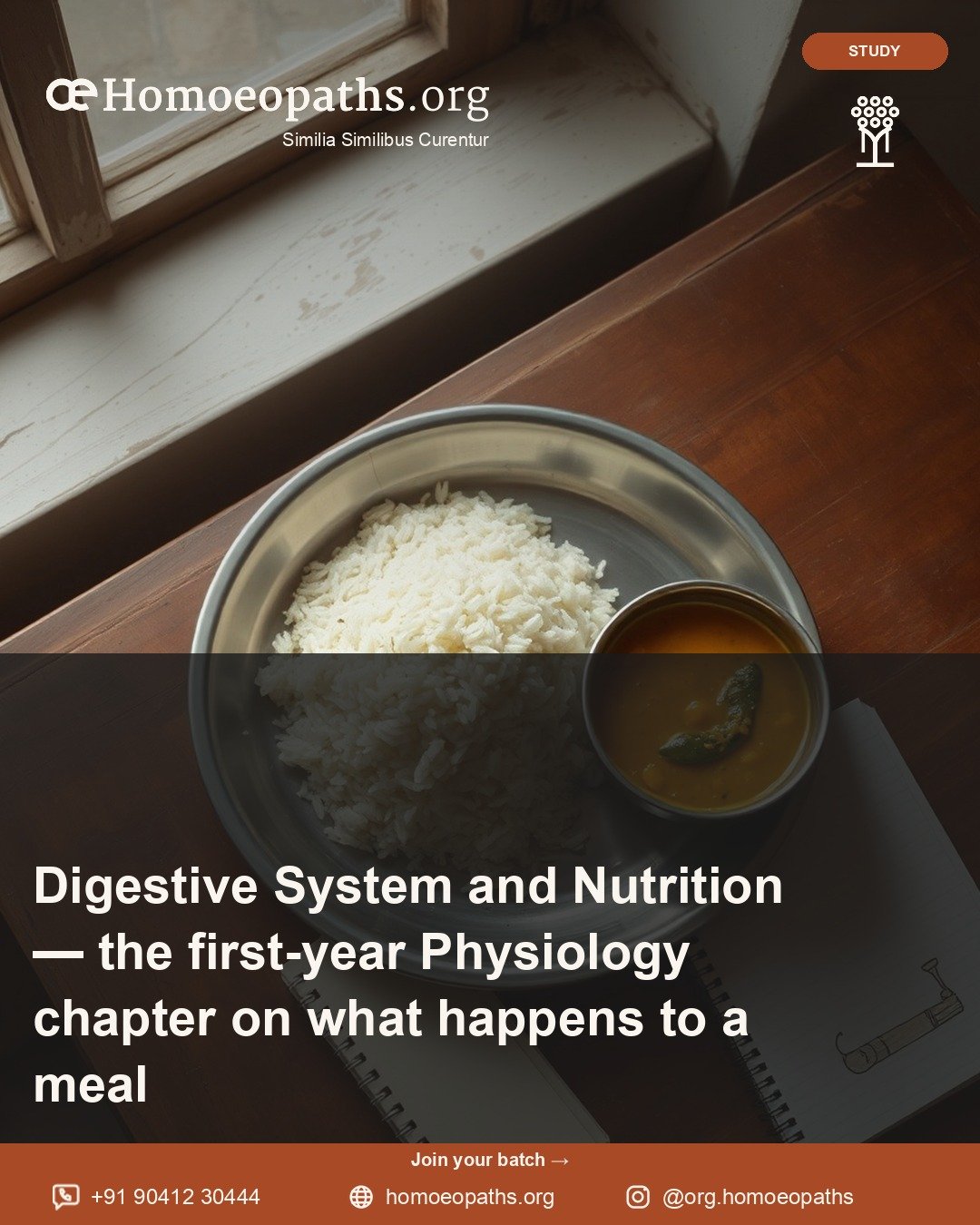
Think of a plate of dal, rice and sabzi. An hour after you eat it, it is no longer dal, rice and sabzi. It has been broken down into pieces small enough to pass into your blood. This chapter follows that plate through the body.
The NCH syllabus gives “Digestive System & Nutrition” chapter twelve of Physiology and Biochemistry (HomUG-PB). The sheet lists six topics. They follow the meal in a sensible order.
Topic one: the introduction
“Introduction to digestive system”. The digestive system is the long tube from mouth to anus, together with the glands that pour juices into it. Its job is to break food down, take in what the body can use, and pass out the rest.
Topic two: the digestive juices
“Composition and functions of digestive juices”.
A digestive juice is a fluid made by a gland and poured into the gut to help break down food. “Composition” means what is in it. “Functions” means what it does.
Several juices are made along the way. For each one, learn the same three things: where it is made, what is in it, and what it does. A small table with those three columns makes this topic easy to revise.
Topic three: the organs
“Physiological anatomy of Stomach, Pancreas, Liver and Gall bladder, Small intestine, Large intestine”.
You have met “physiological anatomy” before, in the Respiratory chapter. It means the structure you need in order to understand the function. The sheet names the organs in the order food, or its juices, meets them.
The pancreas appears here for its digestive work. In chapter nine, Endocrinology, it appeared for its hormones. Same organ, two jobs, two chapters. Keep a note that links them.
Topic four: the movements
“Movements of gastrointestinal tract”. “Gastrointestinal” means the stomach and the intestines. Food does not just fall through the gut. It is mixed and pushed along by the muscle in the gut wall. That is smooth muscle, which you met in chapter five, Nerve Muscle Physiology. This topic asks what kinds of movement there are, and what each one does.
Topic five: the hormones
“Gastrointestinal hormones”. The gut makes its own hormones. They help control when juices are released and how the gut moves. So the hormone story of chapter nine continues here, inside the gut itself. Your textbook will name each hormone and what it does.
Topic six: digestion and absorption
“Digestion and absorption of carbohydrates, proteins and lipids”.
Digestion is breaking food into small pieces. Absorption is taking those pieces from the gut into the blood or lymph. The sheet asks for three kinds of food. Carbohydrates are the starches and sugars. Proteins are the body-building foods. Lipids are fats and oils.
Back to the plate. Rice brings carbohydrate. Dal brings protein. The ghee or oil in the tadka is lipid. So one ordinary Indian meal gives you all three of the sheet’s food types to trace.
A note on “Nutrition”
The chapter title has two halves: “Digestive System” and “Nutrition”. But the six topics on the sheet are all about digestion. There is no separate line on nutrition here.
Tell yourself this plainly, so it does not confuse you. The nutrition side of the year is picked up in chapter fourteen, Bio-Chemistry Theory. That chapter asks for the daily requirements, dietary sources and roles of vitamins and minerals. Ask your teachers how much nutrition they expect under this chapter’s title.
How the chapter sits in the year
This is chapter twelve. It draws on smooth muscle from chapter five and on hormones from chapter nine. It leads into chapter fourteen, where the carbohydrates, proteins and lipids you absorb here are followed into the body’s chemistry. What this chapter takes in, that chapter uses.
The Anatomy paper covers the stomach, liver, gall bladder, pancreas and intestines in its Abdomen chapter. There, you learn how they are built. Here, you learn what they do.
What to take from it
- Build the three-column table of digestive juices.
- Know each organ on the sheet and its part in digestion.
- Explain the movements of the gut and the smooth muscle behind them.
- Know what gastrointestinal hormones do, in general.
- Trace one plate of food from digestion to absorption, for all three food types.
The sheet gives six topics and no detail. The juices, the hormones and the steps of digestion come from your textbook and your teachers.
Where to go next on the platform
This piece sits in the first-year Physiology and Biochemistry room. “Abdomen, Pelvis and Perineum — the first-year Anatomy chapter below the diaphragm” gives the structure behind this chapter. “Bio-Chemistry Theory — the first-year Physiology chapter on the body’s chemistry” follows the food further.
Written by Vaibhav Kumar Rai · Published by Homoeopaths.org · 29 October 2026
"Digestive System and Nutrition — the first-year Physiology chapter on what happens to a meal." Homoeopaths.org. Published 29 October 2026. https://homoeopaths.org/learn/courses/bhms-1st-year/physiology-biochemistry/digestive-system-nutrition-1st-year
More in BHMS 1st year · Physiology & Biochemistry
Physiology & Biochemistry
Central Nervous System — the first-year Physiology chapter on the brain and spinal cord at work
A study guide to the Central Nervous System chapter of first-year Physiology: twenty-five topics, sorted into five groups you can revise.
Vaibhav Kumar Rai · 28 October 2026 · 4 min read
Physiology & Biochemistry
Cardio-Vascular System — the first-year Physiology chapter on the heart and the blood’s journey
A study guide to the Cardio-Vascular System chapter: thirteen topics, from the cardiac cycle and ECG to the pulse, sorted into four easy groups.
Vaibhav Kumar Rai · 28 October 2026 · 4 min read
Physiology & Biochemistry
Bio-Chemistry Theory — the first-year Physiology chapter on the body’s chemistry
A study guide to Bio-Chemistry Theory, the last chapter of first-year Physiology: carbohydrates, lipids, proteins, enzymes, vitamins, minerals and tests.
Vaibhav Kumar Rai · 28 October 2026 · 4 min read
Physiology & Biochemistry
Skin and the Integumentary System — the first-year Physiology chapter on the body’s outer layer
A study guide to the Skin chapter of first-year Physiology: what the integument is, its layers, its work, sweat, and how body temperature is kept steady.
Vaibhav Kumar Rai · 27 October 2026 · 3 min read