
BHMS 2nd year · Pathology & Microbiology
Acid Fast Bacterias — the fourteenth chapter of second-year Pathology and Microbiology
A study guide to second-year Pathology and Microbiology’s fourteenth chapter: the staining property that gives acid-fast bacteria their name.
Homoeopaths.org · · 2 min read
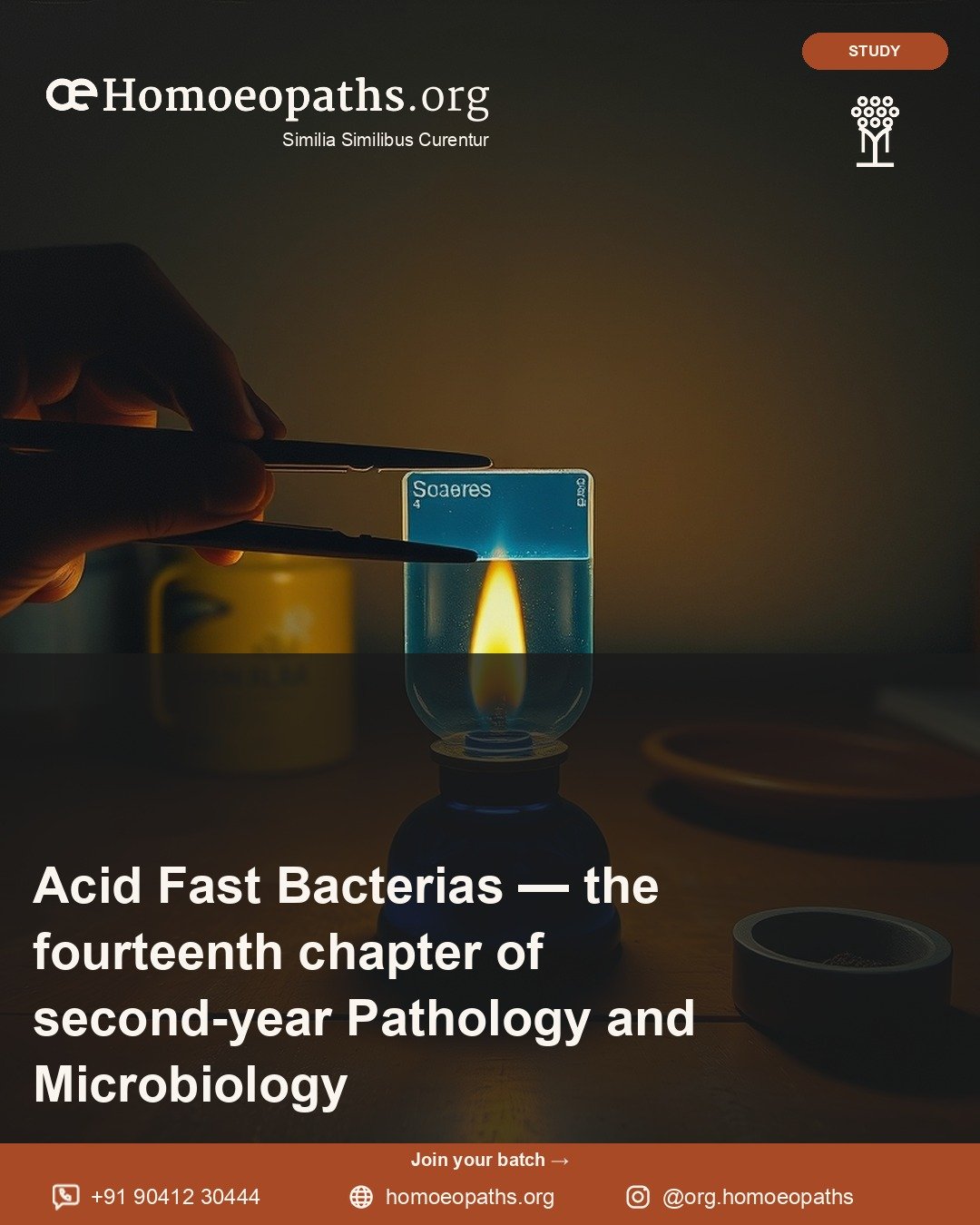
Like several chapters in this stretch of the subject, “Acid fast bacterias” arrives on the CBDC sheet as a title alone. Nothing sits under it. This piece does not add sub-topics the source does not give. It stays with the name and unpacks, in plain words, what that name is describing.
A stain that refuses to wash out
The chapter before this one, “Gram Negative Bacterias,” dealt with a stain that comes off some bacteria and not others. Acid-fastness is a different property again. It is also an independent one. A small group of bacteria have a cell wall so thick and waxy that ordinary staining barely works. The dye sits unevenly and tells a laboratory little. So microbiology developed a separate method for this small group. A strong stain is applied with heat. Then comes a wash meant to strip colour, using acid and alcohol together.
Most bacteria lose the dye under that harsh a wash. The small group this chapter is named for does not. Their waxy wall holds the stain through the acid wash. That is exactly where the name comes from. Acid-fast, because the colour survives an acid strip. Almost anything else would lose that colour.
Why it needs its own chapter
Acid-fastness sits apart from the gram-positive and gram-negative split covered earlier in this subject. A bacterium’s gram reaction and its acid-fastness are two separate facts about its wall. Each is tested a different way. This small group gets a dedicated chapter for one reason: ordinary Gram staining does not serve it well. Its wall structure needs its own test to be seen clearly at all. A student meeting this chapter for the first time should take away one lesson above any other. Not every bacterium is caught by the same net. The acid-fast stain exists because one group slipped through the usual one.
How it sits in the year
The orientation piece for this room is “Pathology and Microbiology in the Second Year — the study of disease itself.” It places this chapter in the bacteria-by-group stretch of the subject. This chapter sits right after “Gram Negative Bacterias” and right before “Spirochaetes,” the next chapter in this batch. Together, the gram-stain pair and the acid-fast chapter give a student three of the laboratory’s oldest sorting tools. After them, the subject moves on to bacteria grouped by shape rather than by stain.
The staining method itself belongs to the subject’s closing chapter, “Diagnostic Procedures in Microbiology.” That chapter gathers every laboratory method from this run and explains them as a set of working tools.
What to take from it
- Acid-fastness is a cell-wall property, tested with its own stain, separate from the gram-positive and gram-negative split.
- The property exists because ordinary staining does not work well on this small group of bacteria.
- A strong stain plus a heat step, followed by an acid-alcohol wash most bacteria cannot survive without losing colour, is the method’s basic shape.
- Keep the named organisms, the diseases they are tied to, and any clinical management out of this piece. Save them for your microbiology text and later clinical years, where they belong.
Written by Homoeopaths.org · Published by Homoeopaths.org · 23 November 2026
"Acid Fast Bacterias — the fourteenth chapter of second-year Pathology and Microbiology." Homoeopaths.org. Published 23 November 2026, updated 29 October 2026. https://homoeopaths.org/learn/courses/bhms-2nd-year/pathology-microbiology/acid-fast-bacterias-2nd-year
More in BHMS 2nd year · Pathology & Microbiology
Pathology & Microbiology
Gram Negative Bacterias — the thirteenth chapter of second-year Pathology and Microbiology
A study guide to second-year Pathology and Microbiology’s thirteenth chapter: what makes a bacterium gram-negative, and why the split matters.
Homoeopaths.org · 21 November 2026 · 2 min read
Pathology & Microbiology
Systemic Pathology — the twelfth chapter of second-year Pathology and Microbiology
A study guide to Systemic Pathology, the twelfth chapter of second-year Pathology and Microbiology, and how it answers back to General Pathology.
Homoeopaths.org · 20 November 2026 · 2 min read
Pathology & Microbiology
Protozoans — the eleventh chapter of second-year Pathology and Microbiology
A study guide to the eleventh chapter of second-year Pathology and Microbiology: what a protozoan is, right after parasitology is introduced.
Homoeopaths.org · 18 November 2026 · 2 min read
Pathology & Microbiology
Introduction to Parasitology — the tenth chapter of second-year Pathology and Microbiology
A study guide to the tenth chapter of second-year Pathology and Microbiology: what a parasite is, and why parasitology follows virology in the room.
Homoeopaths.org · 16 November 2026 · 2 min read