
BHMS 1st year · Anatomy, Histology & Embryology
Upper Extremity — the first-year Anatomy chapter on the arm, from shoulder to palm
A study guide to the Upper Extremity chapter of first-year Anatomy: its regions, nerves, arteries and joints, sorted into a plan you can follow.
Vaibhav Kumar Rai · · 3 min read
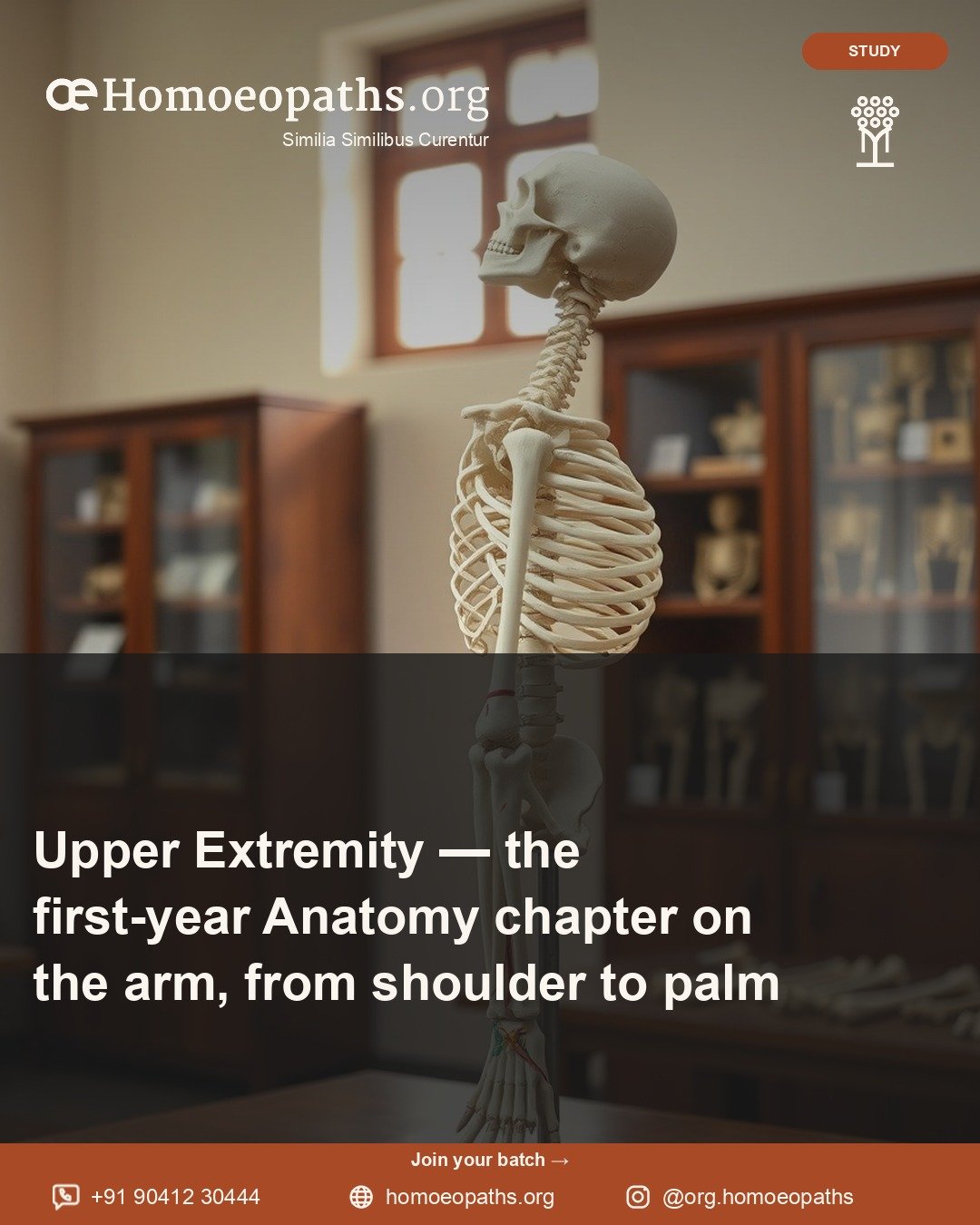
The upper extremity is the whole upper limb. It runs from the chest wall and shoulder down to the fingertips. It is the first regional chapter on the sheet, and it teaches a way of working that you will use for the rest of the year.
The NCH syllabus gives it chapter four of Anatomy, Histology and Embryology (HomUG-AHE). The sheet lists twenty-one lines, from “Introduction” to “Revision”. Twenty-one lines can feel like a wall. This piece sorts them into five groups so you can see the plan.
Group one: where the limb meets the body
- Pectoral region and axilla
- Mammary gland
- Back and intermuscular spaces around scapula
The pectoral region is the front of the upper chest. The axilla is the armpit, a space that many nerves and vessels pass through. The scapula is the shoulder blade. The spaces around it are gaps between muscles that let structures pass. The mammary gland sits in the pectoral region, which is why it is taught here.
Group two: the nerves
- Brachial plexus
- Musculocutaneous and axillary nerves
- Median nerve
- Ulnar nerve
- Radial nerve
A plexus is a network where nerves join and split. The brachial plexus is the network that supplies the upper limb. The other five are nerves that come from it, each with its own path and its own muscles to supply.
Here is a study tip. For each nerve, write the same four headings: where it starts, the path it takes, what it supplies, and what happens if it is injured. Your textbook will give the details. The fixed headings make revision faster.
Group three: the arteries and veins
- Axillary artery
- Arm and cubital fossa; brachial artery
- Radial artery
- Ulnar artery
- Venous drainage of upper extremity
The blood supply runs like one long road that changes its name as it goes. In the armpit it is the axillary artery. In the arm it is the brachial artery. Below the elbow you meet the radial and ulnar arteries. The cubital fossa is the hollow at the front of the elbow. Venous drainage is the path blood takes back to the heart.
Draw this road once, big and clear, with each name change marked. It is a drawing worth making early.
Group four: the joints
- Shoulder joint
- Elbow joint and radio-ulnar articulations
- Wrist joint
“Articulation” is another word for joint. The radius and ulna are the two bones of the forearm. The radio-ulnar joints let the forearm turn the palm up and down.
For each joint, a common set of headings works well: the type of joint, the bones, the ligaments, the movements, and the muscles that make those movements. Chapter one, General Anatomy, introduced joints in general. Here you use that knowledge on real ones.
Group five: the forearm and hand
- Fore arm: muscles, nerves and blood vessels (superficial and deep flexors and extensors)
- Flexor and extensor retinacula
- Palmar aponeurosis and spaces in palmar spaces
Flexors bend. Extensors straighten. In the forearm they sit in layers, superficial and deep. A retinaculum is a band that holds tendons in place at the wrist, like a strap. The palmar aponeurosis is a tough sheet in the palm. The palmar spaces are gaps between its layers. The sheet’s wording, “spaces in palmar spaces”, is copied as printed.
How the chapter sits in the year
The upper extremity comes right after the three general chapters: General Anatomy, Embryology and general Histology. It is the first regional chapter. The lower extremity follows it, and the two share a pattern. Both have a plexus, big nerves, a main artery that changes name, and joints studied one by one. Learn the method well here and the lower limb will feel familiar.
What to take from it
- See the chapter as five groups, not twenty-one loose lines.
- Use fixed headings for every nerve and every joint.
- Draw the artery road from axilla to wrist, with each name change.
- Know the plain meaning of plexus, retinaculum, aponeurosis and articulation.
The sheet gives the topic names only. How far each goes, and which diagrams your exam expects, come from your textbook and your teachers.
Where to go next on the platform
This piece sits in the first-year Anatomy, Histology and Embryology room. “Lower Extremity — the first-year Anatomy chapter on the leg, from hip to sole” follows the same pattern for the lower limb. “General Anatomy — the first-year Anatomy chapter that teaches the language of the body” covers the terms of position and movement that this chapter uses on every page.
Written by Vaibhav Kumar Rai · Published by Homoeopaths.org · 27 October 2026
"Upper Extremity — the first-year Anatomy chapter on the arm, from shoulder to palm." Homoeopaths.org. Published 27 October 2026. https://homoeopaths.org/learn/courses/bhms-1st-year/anatomy-histology-embryology/upper-extremity-1st-year
More in BHMS 1st year · Anatomy, Histology & Embryology
Anatomy, Histology & Embryology
Thorax — the first-year Anatomy chapter on the chest, the heart and the lungs
A study guide to the Thorax chapter of first-year Anatomy: airway, lungs, heart, the mediastinum and its vessels, and the diaphragm.
Vaibhav Kumar Rai · 27 October 2026 · 3 min read
Anatomy, Histology & Embryology
Lower Extremity — the first-year Anatomy chapter on the leg, from hip to sole
A study guide to the Lower Extremity chapter of first-year Anatomy: thigh, gluteal region, leg and foot, with their nerves, arteries and joints.
Vaibhav Kumar Rai · 25 October 2026 · 4 min read
Anatomy, Histology & Embryology
Histology (General) — the first-year Anatomy chapter where the body goes under the microscope
A study guide to general Histology in first-year Anatomy: ten kinds of tissue and organ, seen under the microscope, and how to study them.
Vaibhav Kumar Rai · 24 October 2026 · 3 min read
Anatomy, Histology & Embryology
Head, Neck and Face — the first-year Anatomy chapter where many small parts share a small space
A study guide to Head, Neck and Face in first-year Anatomy: neck triangles, glands, the orbit, mouth, throat, ear, nose and the great vessels.
Vaibhav Kumar Rai · 24 October 2026 · 4 min read